Getting ready for kindergarten: Kindergarten readiness checklist for parents
As the last year of preschool moves along, many parents begin asking the same question: Is my child ready for kindergarten?
The reassuring answer is that kindergarten readiness is not mainly about how many letters a child knows or how high they can count.
It is about helping them feel comfortable managing everyday situations, communicating their needs, participating in a group, and trying unfamiliar things.
What should my child know before kindergarten?
Your child does not need to arrive knowing how to read, write neatly, count to one hundred, or solve math problems.
Academic expectations can vary by school, but kindergarten is designed to help children develop early reading, writing, and math skills.
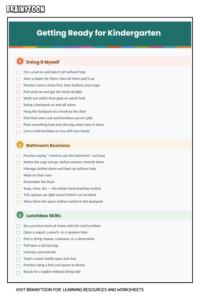
Teachers are often more concerned with whether a child can:
- Open their lunch and manage basic belongings
- Use the bathroom with minimal assistance
- Separate from a parent or caregiver
- Tell an adult when they need help
- Participate in a short group activity
- Follow a simple classroom direction
- Recover from everyday disappointments
- Interact with other children
These skills help children manage their day in a busy classroom where one teacher is supporting many students at once.
A readiness checklist is not a measure of intelligence. It is simply a way to identify which everyday skills may need a little more practice.
Independence with everyday tasks
Putting on a coat, using a zipper, carrying a backpack, and getting shoes on the correct feet may seem like small things. In a classroom, however, they allow a child to move through the day without waiting for an adult each time.
The easiest way to build independence is to let your child practice during normal routines. It may take a few extra minutes in the morning, but repetition is what turns these tasks into habits.
Give your child time to try before stepping in. Help only with the part they cannot yet manage on their own.
Bathroom independence
Children should be able to notice when they need the bathroom, tell an adult, manage their clothing, wipe, flush, and wash their hands as independently as possible.
It is especially helpful to practice the words they may need at school:
“I need to use the bathroom.”
“I need help.”
“I had an accident.”
Opening and eating lunch
Lunch can be surprisingly challenging. The room may be busy, the lunch period may be short, and adults may not immediately notice that a child is struggling with a container.
Before school starts, pack a typical lunch and let your child open everything independently. This will quickly show you which packages, bottles, or containers are difficult.
Practice opening those items at home or replace them with easier options. Your child should also know how to ask for help rather than quietly bringing home an untouched lunch.
Social skills
Playgrounds, library activities, playdates, and community programs can give children opportunities to practice entering groups, taking turns, sharing ideas, and solving small conflicts.
Children also need practice handling situations when another child says no or a game does not go as planned. Encourage your child to try a different activity, ask someone else, or take a short break rather than treating the moment as a disaster.
Managing big feelings
No one expects a five-year-old to remain calm all the time. What helps in a classroom is being able to begin recovering after frustration, disappointment, or a change in plans.
Help your child name feelings such as angry, worried, embarrassed, disappointed, and excited. When children have words for their emotions, they are better able to explain what is happening.
You can also teach one simple calming strategy, such as:
- Taking a slow breath
- Counting to five
- Squeezing and relaxing their hands
- Asking for a quiet moment
- Telling an adult how they feel
Small disappointments provide useful practice. You do not need to prevent every lost game, broken cracker, or change of plans. Support your child while allowing them to work through the feeling.
Listening in a group
Listening to a teacher in a classroom is different from listening at home. At home, you may say your child’s name, make eye contact, and repeat the direction. At school, the teacher may give one instruction to the entire class:
“Everyone, put your papers in the blue bin.”
You can practice this by occasionally giving a direction to the whole family rather than addressing your child individually. Start with one-step directions and gradually introduce two related steps.
The goal is not perfect obedience. It is helping your child notice when a group instruction applies to them.
Asking for help
A child should be able to communicate basic needs clearly enough for an unfamiliar adult to understand.
Practice phrases such as:
“I don’t understand.”
“Can you help me?”
“I don’t feel well.”
“I can’t find my backpack.”
“Someone took my turn.”
A child who can ask for help has an important tool in a room where the teacher cannot see every problem immediately.
Books, letters, and early reading
Children benefit from recognizing some letters, especially those in their own name, but they do not need to read before kindergarten.
The most useful preparation is reading together regularly. Through books, children learn that print carries meaning, stories follow a sequence, pages move in a particular direction, and reading can be enjoyable.
Read picture books, let your child turn the pages, talk about the illustrations, and ask what they think might happen next. Repeating favorite books is valuable because familiarity helps children notice new words, details, and patterns.
Numbers and early math
Early math is about understanding quantities, patterns, shapes, and comparisons—not memorizing long strings of numbers.
Look for math during everyday routines:
- Count the stairs as you climb
- Put one fork beside each plate
- Compare which pile has more
- Sort laundry by color or size
- Look for shapes around the house
- Count out a specific number of crackers
Touching each object while saying one number helps children understand that each number represents an actual quantity.
Fine and gross motor skills
Fine motor skills support writing, cutting, gluing, buttoning, and opening containers. They develop through hands-on play rather than worksheets alone.
Useful activities include drawing, playdough, building blocks, child-safe scissors, beads, puzzles, stickers, and tearing paper for crafts.
Gross motor skills help children participate confidently in playground and physical activities. Running, climbing, jumping, balancing, throwing, and catching all support coordination and body awareness.
Readiness activities that fit into your week
You do not need a formal kindergarten-preparation curriculum. Most readiness skills can be practiced during routines you already have.
In the kitchen, let your child set the table, count ingredients, sort utensils, pour water from a small pitcher, and open snack packages.
In the car, look for letters and numbers on signs, play rhyming games, or take turns describing something that happened during the day.
At the playground, give your child room to approach other children and work through minor disagreements before stepping in.
At bedtime, read together, talk about the story, and let your child predict what might happen next.
In the bathroom, encourage independence from start to finish while remaining available when help is genuinely needed.
Choose two or three skills to practice at a time. Let them become familiar before adding something new.
Worries you can let go of
“My child cannot write their name.”
That is something teachers can help children develop. Continue offering crayons, pencils, chalk, and other drawing materials without turning handwriting into a test.
“My child does not know every letter.”
Children begin kindergarten with a wide range of early literacy skills. Reading together and noticing letters naturally are more useful than pressuring your child to memorize them all.
“My child is shy.”
Shyness is a temperament, not a failure. Tell the teacher that your child may need time to warm up. Familiar routines and a supportive classmate can help the classroom feel safer.
“My child is one of the youngest students.”
Several months can make a noticeable developmental difference at this age. Avoid comparing your child with the oldest students in the class. Look at their individual progress over time instead.
“We speak another language at home.”
Continue speaking, reading, and singing in the language your family knows best. A strong home-language foundation supports communication, relationships, and future learning. Let the teacher know which languages your child hears and uses.
What matters most
More than anything, your child should arrive believing that school is a safe place, that the adults are there to help, and that trying something new is okay even when it feels uncomfortable.
That confidence comes from the way you talk about school, from acknowledging that first days can feel strange, and from giving a warm, brief, and reassuring goodbye.
Your child does not have to arrive knowing everything. Learning is what kindergarten is for.