Fun facts about ants for first graders
Did you know that ants have lived on Earth for more than 100 million years? That means ants were here long before humans.
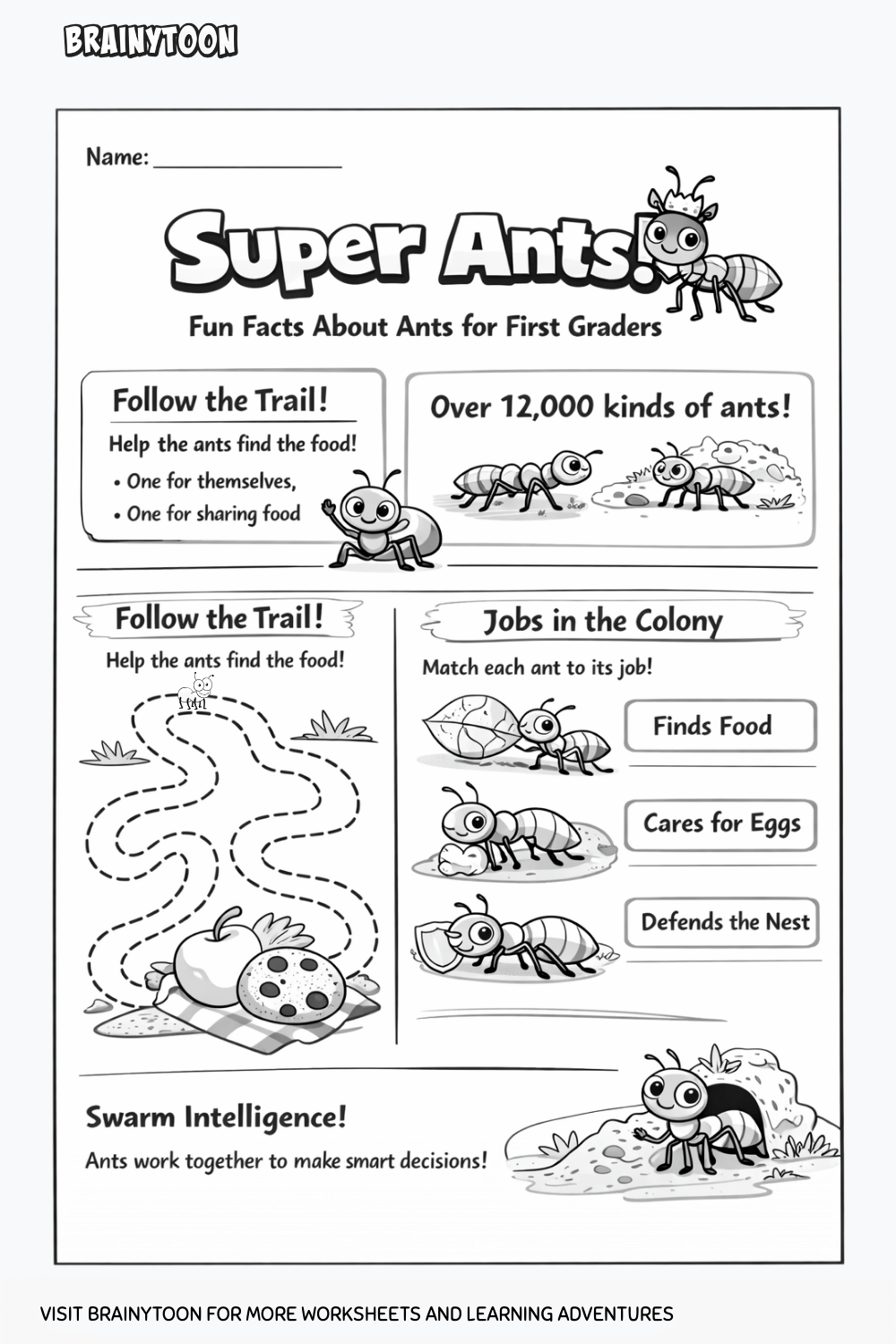
Ants are found almost everywhere in the world except Antarctica. Scientists have discovered more than 12,000 different species of ants.
Here are some fascinating ant facts for first graders:
- Ants have two stomachs — one for themselves and one for sharing food with other ants.
- Some ants can lift up to 50 times their body weight.
- Ants live in large groups called colonies.
- A colony can have up to 500,000 ants.
- Every ant in the colony has a specific job.
How ants work together
Ants are highly organized insects. In a colony, each ant has a role. Some ants search for food. Others build and repair the nest. Some care for the baby ants, and others protect the queen.
The queen ant’s main job is to lay eggs so the colony can grow.
Ants work together as a team to survive. Their teamwork helps the colony stay strong and safe.
How ants communicate
Ants do not speak like humans, but they are excellent communicators.
They use pheromones, which are special chemical scent signals. Other ants detect these signals with their antennae.
When a scout ant finds food, it leaves a pheromone trail behind. Other ants follow the trail to the food source. As more ants walk along the path, the trail becomes stronger and easier to follow.
Vibrations and touch
Ants also communicate through touch and vibration. Inside the nest, they gently tap each other with their antennae to share information.
These signals enable ants to coordinate their work and respond quickly to potential dangers.
Making decisions together
Ant colonies can make smart decisions as a group without one ant being in charge. Scientists call this swarm intelligence.
When ants search for food, they explore in many directions. If one ant finds food, it leaves a pheromone trail. As more ants follow it, the strongest trail leads the colony to the best food source.
No single ant creates the plan. The colony works together to find the most efficient solution.
Examples of questions for class discussions:
- What did you learn about ants?
- Why is teamwork important for ants?
- How can we work together like ants?